


Market Context And Stakes
New York City is not a gentle market for lawyers. Martindale lists roughly 10,000 law firms and about 134,000 attorneys, all competing for the same moments of client attention.
At the same time, NYC is exactly where many attorneys want to be. It is a major financial hub and the center of U.S. business activity, which makes it one of the most attractive places to build a practice that handles complex, high-value matters.
Naturally, doing great work in this market is standard. The real differentiator is whether your firm is discoverable when scared clients, in-house counsel or business owners type their problem into Google, Maps or an AI assistant in search of a clear local answer.
This online search is where the true harshness of the competition begins. Smaller law firms are losing because they are trying to stand out in one of the most crowded legal environments in the country without a visibility system that matches the competition.
How Lawyers Actually Promote Themselves
Most New York firms do not rely on a single channel to get noticed. The firms that consistently win are showing up, with proof of expertise, in the exact places where searchers expect to find an answer. They promote themselves through a mix of content marketing, networking, referrals, and visibility on the same platforms where potential clients already search for legal help, all under New York’s attorney advertising and solicitation rules.
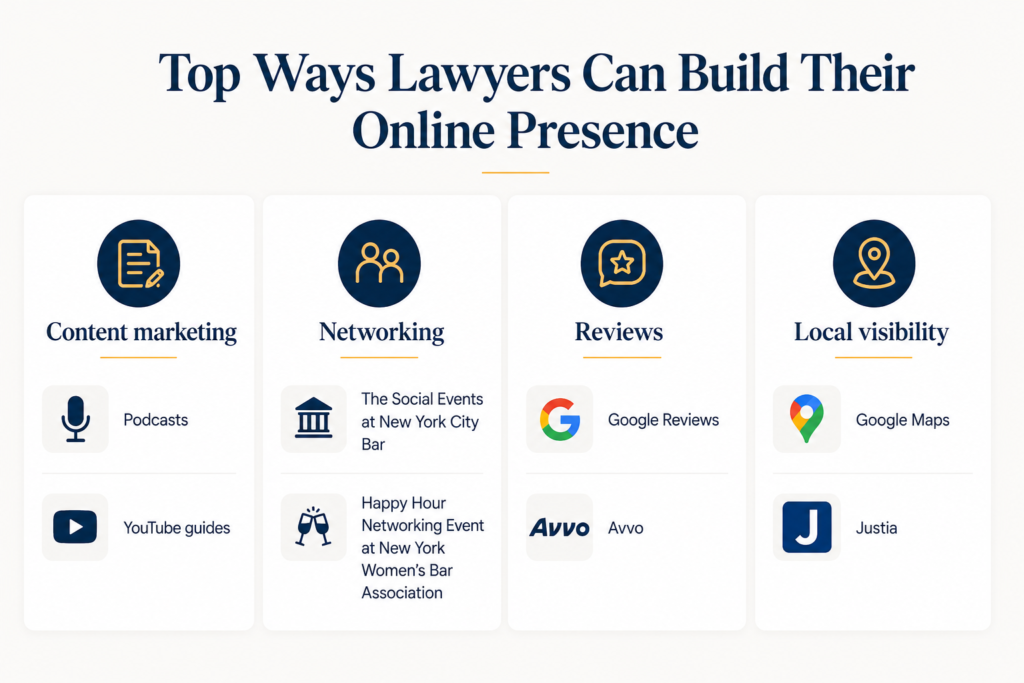
This is the operating principle: be where your clients are already looking. Top‑ranking NYC law firms on Google attract roughly 2,000 to 10,000 visitors per month, and those visitors are not casual browsers—they are people actively searching for legal services. You do not have to persuade them that they need a lawyer (in fact, it goes against federal bar regulations); you have to make sure your firm is the one they discover instead of the competitor whose site is already tuned for search, Maps and AI answers.
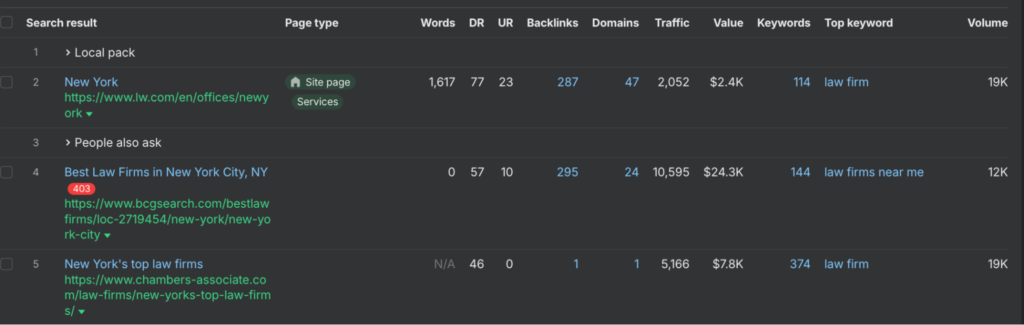
How People Search For Lawyers In Big Cities (Location Layer)
In big cities like New York, nobody sits down and types “lawyer” into a search bar and then calmly browses for half an hour. They search in a hurry, usually from a phone, for a specific legal problem tied to the part of the city they actually live or work in. Many neighborhoods function like separate cities because crossing town takes time, and when someone is scared, angry or facing a deadline, distance and familiarity matter more than abstract prestige.
You can see that reality in the queries themselves. Instead of ‘personal injury lawyer NYC’, people look for “personal injury lawyer Brooklyn,” “divorce attorney Upper East Side,” “Queens immigration lawyer,” or “car accident lawyer Manhattan.” Even when they do not spell out the borough, Google and other systems quietly use device location to prioritize firms that look geographically relevant to that user.
AI assistants push this further. Their job is to recommend options that are not only legally relevant, but also convenient: close enough, clearly serving the right practice area, and clearly open for contact. If your site and profiles do not make your geography and specialization obvious, AI has almost nothing to work with, and you quietly drop out of the recommendation set.
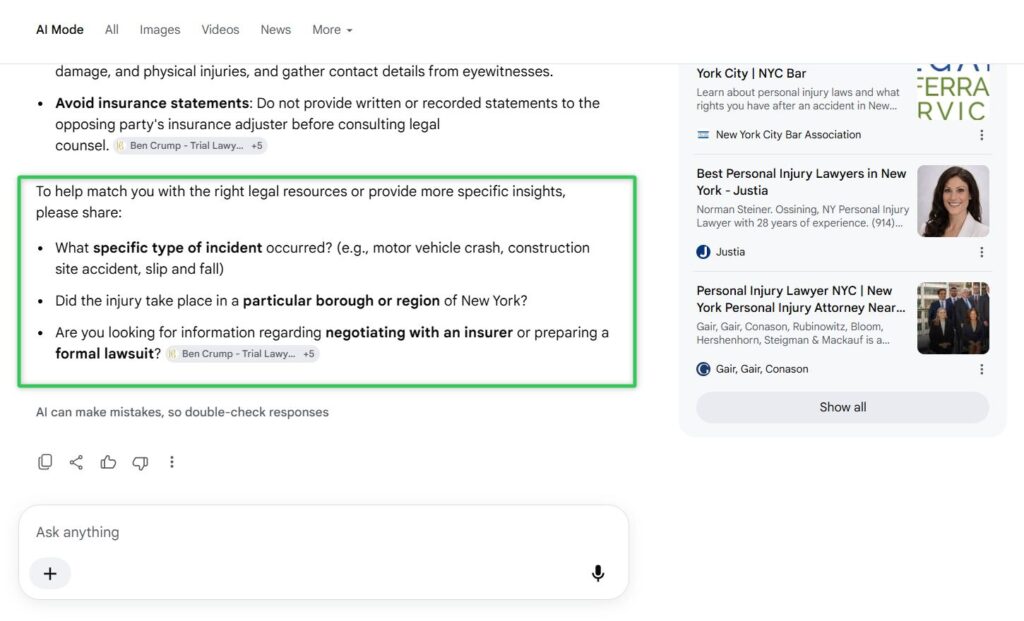
AI Changes The Search Model and The Work Behind It
AI has changed legal search in two ways. First, people are asking longer, more specific questions. A search that once looked like “immigration lawyer NYC” may now look more like: “I live in New York and my wife is abroad. What are the steps to bring her here on a family visa?” That shift matters because AI systems do not simply rank one page for one keyword. They assemble answers from sources that appear clear, relevant, and trustworthy for the situation being described.
For law firms, this makes visibility less about publishing a large volume of generic content and more about having a site that clearly connects the dots: the legal matter, the client’s question, the location, and the firm’s actual ability to help. Ranking in Google and appearing in AI-generated answers overlap, but they are not identical outcomes. A page can attract educational traffic without producing many consultations; a well-built service page may do far more for intake. The point is not to abandon SEO for “GEO.” It is to build a visibility foundation that works across both.
AI can also make that work more manageable. It can help identify gaps in practice-area and local coverage, monitor what competing firms publish, surface technical issues, and turn approved expertise into structured content briefs or first drafts. But AI cannot decide what your firm should be known for, verify legal accuracy, or create trust where the underlying site is vague. It can accelerate a system. It cannot rescue a weak one.
For a law firm, the practical priority remains straightforward:
- Make your practice areas and jurisdictions explicit
- Publish pages around real client situations, not generic topics
- Keep Google Business Profile and local information accurate
- Use AI to support research, prioritization, and production
- Keep legal, editorial, and bar-compliance review under human control
Does SEO Still Matters For NYC Law Firms?
Yes. In a city where thousands of people use Google and AI tools every day to find lawyers, SEO is still one of the clearest ways to get in front of qualified clients. New York is full of firms with serious budgets and strong organic visibility, so the challenge is to use it with focus instead of chasing broad vanity keywords.
If SEO is used wisely and in line with the current development, when someone searches for the services you provide, your firm appears instead of a competitor’s. Simply chasing generic phrases like “NYC lawyer” or “New York law firm” throws you into the same lane as everyone else with more spend. Modern SEO works better when you lean into specificity—practice areas, case types, locations and the exact questions clients ask when they decide whom to call.
Website positioning and structure
Search favors clarity over generality. People look for “Manhattan commercial lease attorney,” “Brooklyn personal injury lawyer for cyclists,” or “NYC startup employment attorney,” not for “NYC lawyer,” so your site has to mirror that behavior with specific, practice‑area‑plus‑location pages instead of vague labels. A homepage framed as “Personal Injury Law Firm in NYC” sends a stronger relevance signal than “NYC law firm,” and a “Car Accident Lawyer” page will consistently beat a generic “Services” page for car crash queries, because it gives Google, Maps, and AI systems a precise, defensible reason to surface your firm for those searches.
Content around real cases & questions
People do not search for “lawyer” in the abstract; they describe the situation they are in—“bicycle accident lawyer in NYC,” “Can I sue the city for poor road conditions?” “Who is liable for a bicycle accident caused by potholes?” or even, to an AI assistant, “I fell off my bicycle in the city because of poor road conditions and there were no warning signs. Can I get compensation?” Your content has to meet that level of detail: pages built around real legal scenarios, clear options, and specific jurisdictions give search and AI systems enough context to match you with people already looking for help, which is where SEO stops being theory and starts turning visibility into calls, consultations, and new clients.
The SEO Matrix: Case × Location × Solution
If you want SEO to work for a New York law firm, stop thinking about “ranking for one big keyword” and start thinking in terms of a scalable content structure. The simple operating formula is:
- Real legal case or problem – what actually happened.
- Location – where it happened.
- Your legal solution – how your firm can help.
When you build your site around that pattern, each page becomes a precise answer to a high‑intent search, instead of another generic “services” brochure.
Below is how that looks in practice:
| Real case | Location | SEO page title |
| Car accident | Brooklyn | Car Accident Lawyer in Brooklyn |
| Truck accident | Queens | Queens Truck Accident Attorney |
| Bicycle accident | Manhattan | Manhattan Bicycle Accident Lawyer |
| Slip and fall | Bronx | Bronx Slip and Fall Attorney |
| Medical malpractice | Staten Island | Staten Island Medical Malpractice Lawyer |
There is room for even narrower searches that target the exact kinds of searches and AI questions people actually make when in need:
- bicycle accident caused by a pothole in Brooklyn
- Uber accident lawyer in Manhattan
- construction accident attorney in Queens
- pedestrian hit by a taxi in Midtown
- dog bite lawyer in the Bronx
These pages give Google, Maps and AI assistants a clear case‑plus‑location signal they can confidently match to live queries.
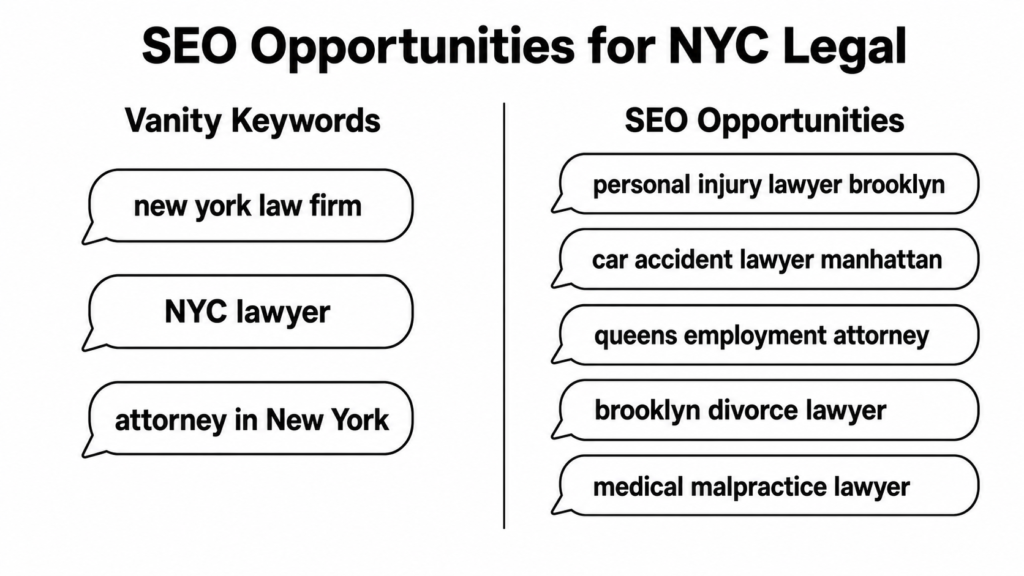
Over time, case type × location × legal solution becomes your operating system for SEO. Rather than relying on one catch‑all page, your site turns into a network of tightly targeted pages that build topical authority, strengthen your organic visibility, and attract clients who are already searching for exactly what you do, where you do it.
Moving Beyond SEO Theory: Numbers And ROI
Can SEO generate clients and a clear return for a New York law firm?
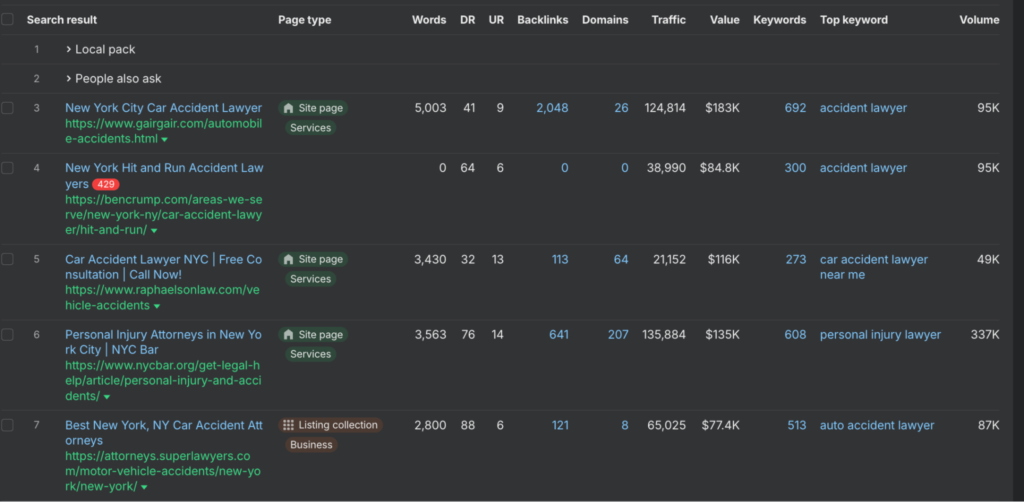
The easiest way to answer that is to look at how individual practice‑area pages perform in the real world. In car accident law alone, some NYC firms have pages that attract thousands of visitors per month, rank for hundreds of keywords and generate traffic worth tens of thousands to over $180,000 per month in Google Ads equivalent.
Evidently, you do not need to capture the entire opportunity for SEO to be meaningful. Even taking 20–50% of the available search demand in one practice area can be enough to move the needle.
Step 1. Traffic slice. Let’s assume your pages capture around 2,000 qualified visitors per month in one practice area.
Step 2. Visitor → Lead. If the contact rate is 5%, then leads per month is 100 (2,000 visitors × 5%).
Step 3. Consultation → Client. If consultation‑to‑client conversion is 20%, then new clients per month is 20 (100 leads × 20%).
Step 4. Revenue. This part of calculation is the most exciting. With an average case value of $10,000–$20,000+, the monthly revenue impact may equal $200,000–$400,000+ from that one slice of search, on conservative assumptions.
| Step | Conservative assumption | Result per month |
| Qualified visitors | 2,000 | 2,000 visitors |
| Contact rate | 5% | 100 leads |
| Consult‑to‑client rate | 20% | 20 new clients |
| Average case value | $10,000–$20,000+ | $200k–$400k+ rev. |
This is a reliable approximation for how even modest conversion rates can make structured SEO work feel like infrastructure — something that routinely turns visibility into clients and revenue, rather than another traffic chart in a vacuum.
Your job is to build a website and profile system that capture the existing demand — pages, practice‑area coverage and local signals that make it easy for search and AI systems to match you to the right matters. That is what a well‑executed law firm SEO strategy is designed to do: turn existing search intent into discoverability and discoverability into clients.
SEO As A Business Asset, Not A Marketing Expense
In New York, a firm’s problem is when someone finally sits down to look for help on Google, Maps, or an AI assistant they see competitors first. A new SEO edge for any law firm, small or established, is an online presence built around real questions, real matters and the places they actually serve.
When your site makes three things unambiguous — what you do, where you work and why you are credible — it stops behaving like a glossy brochure and starts functioning as an informational hub for intake. Paid ads taper off as soon as you pause, while a structured SEO presence keeps pulling in qualified searchers month after month, page by page.
Are people searching for legal services in New York? Definitely. But the more useful question is: when they look for the services you provide, does your firm show up with enough clarity for them to trust and contact you or does a competitor’s structure do that job instead?
Thinking about SEO as part of the firm’s business infrastructure — an asset that underpins intake and growth—rather than as a disposable marketing expense is what turns visibility work from “nice to have” into a predictable way to win better matters over time.